Notes on playing the banjo uke (and the regular ukulele), as well as some of my favorite songs and videos, but mostly, you'll find information here on my particular obsession - the many models of banjo ukulele offered by Stromberg-Voisinet in the 1920's to 1931.

Saturday, August 25, 2012

Update on Stromberg-Voisinet Auctions


August is my favorite month of the year. The horrible heat and humidity of July are over, and even though the days are getting noticeably shorter, the nights are cool and drier, and I take the banjo ukes out again.


And speaking of banjo ukes, an auction just ended on eBay this week that's notable because it's the highest price I've yet logged for a Stromberg-Voisinet ukulele. This "Buster Brown" is the less ornate model, as you can see - no perloid, no fretboard binding and the simpler resonator back. As you can also see, some alteration has been made to the dowel, but for what purpose I can't imagine.


This instrument just sold at the remarkable price of $600 USD. The last "Buster Brown" I saw that even approached this was one that moved earlier this year for $500 USD. Prior to that, all prices have been in the $250 to $400 range.


"New" Models
There has been a recent flurry of Stromberg-Voisinets offered at online auction, and a few stand out. First, one "Rose" model has been offered six times over the last three months. It's missing its resonator and has had a bad head repair - attaching the head to the rim with shoe goo or similar. This will be fairly difficult to sell, but that hasn't stopped the owner from asking for $299 initially and then dropping to $199.

It is still available as of writing. I post this because instruments with missing resonators come up fairly frequently, and occasionally, we see S-V ukes with split resonators. It appears to be an uncommon, but definite flaw; resonators were made in two or three pieces, and occasionally, the glue dries out or stress cracks the instrument right along the join lines.


Here are the two instruments worth noting from the last couple of months. Both are completely new models to me.


The first is the "Glee Club" banjo ukulele - according to the seller, it was offered by Bruno, NY. By the 20's Bruno wasn't actually making any banjo ukuleles; they jobbed out their work to several companies, including Lange in New York and Richter in Chicago. Apparently, they also commissioned instruments from Stromberg-Voisinet.


The seller posted this excerpt from a Bruno ad: "It has 8-inch heavy laminated maple shell (9/16" thick) in dark mahogany finish with fancy color wood inlaid strip around rim, 16 nickel-plated brackets, heavy U grooved nickelplated straining hoop, three-piece neck in dark mahogany finish, headpiece inlaid with fancy pearl ornament and name "Glee Club" in imitation ivory.

"Ebonized fingerboard with four pearl position dots, patented nickel-plated friction pegs with white buttons, heavy neck brace. Instrument fitted with quick-detachable convex extension resonator in dark mahogany finish with handsome inlaid ring of fancy colored woods, top edge of wood inlay and celluloid bound, Grover Presto nickel-plated tailpiece."


Interesting, as neither the illustration of the instrument nor the real instrument match the ad description exactly. There are only 12 brackets - nor is there a Grover 'Presto" anywhere in evidence - instead, it's the usual Stromberg-Voisinet shop choice - known now as the 'economy' tailpiece.

Despite the ad being at odds with reality, that inlay on the rim of the resonator is unique, and this headstock is the one that S-V seems to have reserved for their 7" pot models - along with that badge style that we've seen on Wizards. This example sold for $195, a very good price considering condition and rarity. It's exciting for me to have uncovered a new model at this point.


Here's another. An open-back model, blond with a dark double pinstripe - an 8" pot with 12 brackets, dark stained headstock and ebonized fretboard. It's missing any of the inlaid purfling all other S-V open backs we've seen so far have had. It's also the only 8" open back we've seen with 12 tension hooks.


OK, it's pretty basic - not a model we've seen before when I posted this entry on S-V open backs. The seller of this one has been asking $399 USD for weeks. But, with a large missing section of pot cap, $75 is closer to the mark - $150 with a nice vintage soft shell case the seller is also offering.

By now, you may be asking - hey, what's with all the steel strings on these ukes? I've been wondering the same thing. Ghastly, eh?

Anyway, that's what's new for this week. Next time, back to cataloging the NY manufacturers. Lange is next on the agenda, one of the most prolific manufacturers with a dizzying array of styles, we'll break Lange down into two entries, just so you don't get bored out of your gourds. :D

Until then, keep on strumming'...

Saturday, August 18, 2012

Oscar Schmidt Ukes, Old and New


Well, I mentioned that I'd quit my job, and naturally, you would think I might have more time to post, but you'd be wrong. I have three clients, added about a month ago, and I'm back to a full work schedule. Ah, well. Happy to be busy with clients I really like.

This post is going to be a look at Oscar Schmidt - the defunct "real" one and the current "fake" one.

I feel it's kind of important to do this because Oscar Schmidt was a company that introduced hundreds of thousands of Americans to music. They built cheap, durable instruments including autoharps, guitars, ukes and banjo ukes under the brand names of Stella, La Scala and Sovereign, and built no-names for several department stores and
music stores. Like many others in the 20s and 30s, Doc Watson received a Stella as his first guitar. But Oscar Schmidt went bankrupt, like many firms, in the 30s. They sold off their Stella, Sovereign and La Scala lines in 1939 to Harmony, which continued to sell Stellas door-to-door until 1965, but Oscar Schmidt had ceased to be long before that. Gone.

So, why is there still a company called Oscar Schmidt out there? Caveat Emptor. DO Not confuse the Oscar Schmidt that operated out of Jersey City with the current manufacturer of the same name: http://www.oscarschmidt.com/ The fact is, the name, lying unused, was picked up by US Music Corporation, and there are now all kinds of Schmidt ukuleles out there, all of them new, many of them quite good, but none of them having ANYTHING to do with the old firm.
The fact that their website implies that the company founded in 1871 is the same as the current firm should give you a lesson in "Classic Brand Marketing". Look at the new Pabst Blue Ribbon (not the same company as the old one, just the same trademark), or Gretsch guitars and ukuleles (a sub-brand of Fender, and not the same as the original firm out of Brooklyn, NY). Both brands died out decades ago and then, were bought up or taken over by other firms so they could acquire a brand with a ready-made reputation. It's all about a marketing short-cut, and it works. I don't know how many times I've had a knowledgeable musician tell me about how Oscar Schmidt ukes have a great heritage because their shop has been in operation since 1871. Not. remotely. true.

OK, enough rant. What are the earmarks of Schmidt banjo ukes? They're pretty recognizable.


Headstock - headstocks are like fingerprints - and Schmidt's was a three-pointed headstock similar to the one that Martin has always used on their ukes.


Neck and heel - Schmidt's have a very distinctive square heel. No one else did this, to my knowledge. This is a great indicator you've got a Schmidt banjo uke. Where the headstock and neck meet, the carving forms a letter 'v' with curved sides. MOP markers are on the fifth, seventh and tenth frets.

Pot - depending on the model, Schmidt's pots vary in features, but the construction is almost always light and on the thin side. In the very cheapest of Stellas and Schmidts - those with only eight tension hooks, that pot laminate is about a third of an inch in thickness and reinforced with two chrome bands.
Very light - and you'll notice, often no longer circular after 80 years of being under tension. On Sovereigns, when clear-finished, the thicker pot has two dark double pinstripes and a chrome tone ring that wraps over the top of the pot and halfway down the side - very similar to a Bacon Silver Bell. You can find a Sovereign in the second and third photos from the top in this post. Sovereigns and the better model Stellas have 12 tension hooks. All Schmidts have basic hex-shaped shoes.


Finish - variable, but distinctive. Schmidt commonly used crackle finish, which was a fairly unique choice, as pictured in this Sovreign here. They also used clear finishes commonly, and frequently used paint. Russet red is very common, but so is black, with green and blue being rare, but wonderfully bright. Pearloid is uncommon, but is seen on the fretboard sometimes and rarely on the headstock.


Resonators - not that common, but when present, they are open resonators without a flange. On resonator models, Schmidt used a unique circular design on the back - pictured here and on the Green model below.

Dowel - on Stellas and Sovereigns, often the brand is cold-stamped into the dowel (as you can see in the third photo in this post), but not always. And on Schmidt no-names, there's...well, no name. I have never seen a La Scala, but one assumes that they were likely branded on the dowel, as well as the headstock.

Often, you'll see the brand-name Stella embossed into the headstock and painted. Sometimes, you'll see the brand-name, Sovereign, on a headstock plate. What you will NEVER see is the name Oscar Schmidt on the headstock. They never branded their instruments with the firm's name.


How are Schmidts to play? I've only played one, the thin pot, banded model. Bottom line, this one was not great. The neck was slightly twisted and the pot was out of circular, and it was poorly set up with very high action. I long to play one that's in good shape or well restored. I had a Stella guitar years ago and, though clearly not a Martin, it had a great feel and distinctive twangy tone to it and was a joy to play. I expect one of the instruments that you see here, especially this "Emerald City" belonging to Jake at the Wildwood Flower, must be a lot of fun to play.

That's all for now, as it's getting late. Until next time...keep on strumming.

Wednesday, June 20, 2012

Albert Houdlett and Sons


It's the first day to crack 90 degrees here in NYC - it feels like about 97 out there, so everyone is hunkered down, staying in the air conditioning. As long as I'm stuck indoors, I thought I'd put a spotlight on a New York City banjo ukulele manufacturer whose products have suddenly been coming up for sale with some frequency.


I'm not talking about the more well-known makers of William Lange, Fred Gretsch or Bruno NY, but the Albert Houdlett & Sons Drum and Banjo Company of Brooklyn. Founded in 1865, Houdlett was actually one of the busiest and most profitable banjo and drum manufacturers in New York, and they stayed in business until forced to close their doors in 1930, presumeably as a result of the depression.


Houdlett made several lines of banjo, Nu-Way, Nu-Art and Lynbrook (which, of course you noticed, is a transliteration of Brooklyn). At the height of the banjo uke craze, Houdlett was producing banjo ukes under all three lines, and but their differences aren't always obvious or consistent. It seems that Nu-Way was the cheapest line, with Lynbrook topping the lines in quality and price.


Above and here are a few shots of two Nu-Way open back ukuleles. There
s one with 12-brackets and it's painted white and a second has 16 brackets and appears to be stained maple. Several Nu-Ways, including closed-back and resonator-backed models, have come up for sale in the last year, with three moving on eBay this June, going for between $42 (in bad shape) to $129 in fair condition. It's rare to find Houdlett banjo ukes in good to excellent condition. I don't think they were babied - they seem to have been played and used to the point of disrepair. Still, they are well-made instruments, sturdy and tough.

They share a few features that make it easy to spot them, and yet, these features are remarkably inconsistent, nor do Houdletts always carry a label or maker's plate - making it frustrating to identify them on occasion.


They share a few features that make it easy to spot them, and yet, these features aren't always consistent, no do they always carry a label or maker's plate - making it frustrating to identify them on occasion.


The distinctive Nu-Way headstock is shown here, with both a name plate on this white-painted openback, and a decal on this larger, 16-bracket Nu-Way model.


Houdletts also often have MOP fret position markers, but not always. When they do appear, they're found - uniquely - on the 3rd, 5th, 7th and 10th or, as is more typical, at the 5th, 7th, 10th and 12th frets. You'll also note another of the common features of Houdlett ukes - the long heel. Like everything about Houdlett, it varies, from 2.5 to nearly 4 inches long, but always very rounded, another distinguishing mark, along with the headstock.

But, sadly, that headstock isn't consistent either from model to model. Here's a Nu-Art with a three-pointed headstock similar to that of a Gretsch or a Martin. And, on occasion, you'll see Houdlett banjo ukes with a nearly square headstock.


Interestingly, though you can only see a glimpse of it - the closed-back Nu-Art pictured here has portholes or grommets that you usually associate with the Gretsch Clarophone banjo and banjo uke, and often, these Nu-Arts are mistaken for Gretsches. That's not surprising when you consider that Friedrich Gretsch was employed by Houdlett beginning some time after he arrived from Germany in 1873, and he served under Houdlett for several years, rising to the position of foreman before striking out on his own to found the company that bore his name in the 1883. Even the headstock is similar to the Gretsch headstock, - though the Gretsch banjo uke headstocks all have a pronounced semicircular keel on the back, unlike the Houdlett headstock.


Finally, here's a Houdlett Nu-Way with a resonator. As you can see, the headstock is similar to the Nu-Art above and unlike the other Nu-Ways pictured. These all come from the mid to late 20's, so the inconsistency within the same model line is odd, but there it is...


The resonator has no flange, and attaches in the center with a bolt that goes through the dowel. This particular one requires a lot of work, like most of Houdlett's surviving ukes seem to.

One note: clearly, you can see in the photos of the white Nu-Way that the action is unplayably high and there's what looks to be a 5/8" banjo bridge holding up the strings. If anyone out there is thinking of restoring a banjo uke, let that photo serve as a potent "What not to do." Please folks, that action should be low. I like the strings at the first fret to be able to keep a business card inserted between strings and fret wire in place. And those three-foot bridges don't work nearly as well, nor sand down as well, as two-foot bridges or the two-footers with central ebony supports. I have a whole box of three-foot bridges useless for banjo ukes that will go on eBay one of these days.

In summary, Houdletts are cheap and seem to be coming up for sale with more frequency. They're very affordable, but require a lot of work to get them into good nick, meaning new brackets, vellums, bridges, nut, and other essentials. But, they represent what was one of Brooklyn's most important music companies for many years.


Next time, more on one of the New-York-based manufacturers and still more to come of the remaining models of Stromberg-Voisinet ukes. Until then, happy strumming, and keep cool...


Thursday, June 7, 2012

The Dumber They Come...

Well - turns out that Google has seen fit to revise their Blogger platform without any warning - which has resulted in a couple of draft posts disappearing and at least one follower, the extremely knowledgeable Terry Dennis, disappearing and having his subscription cancelled. Please, if any of you have experienced a similar loss of subscription, please let me know. I don't know that I can get it fixed, but I want to try.

In recent news, I left my job. It wasn't working out and to maintain some sanity, I had to leave. I feel about a million times better, and I've had about 12 interviews in the last three weeks, so that's been actually very good.

I've also had time to post a few pieces on You Tube. You might enjoy this one, "The Dumber They Come", a tune that Eddie Cantor introduced in 1920 at the Ziegfeld Follies.


http://www.youtube.com/watch?v=q3iVsJ-WWL8
I use a number of Formby-style strums here - notably, the triple, the split stroke and the fan.

I also use a thumb strum under the vocals. I use a double-time strum a lot, not a Formby strum per se.

I'm playing my Gibson UB2, which is a joy to play. The action is low, perfect for Formby style playing, and despite being built in the mid-20's, this uke is in great shape aside of a few minor dings and a repaired crack in the heel. At $480, this uke was a bargain, and probably the best value in Gibson UBs. It's got the sound of the much more expensive UB3, but it's routinely selling at auction for between $450 and $600, about half to 1/3 the cost of its more ornate big brother.

This is the first video I've done that got picked up by UkeToob, so I'm pretty excited about that. :) If you want to see it there, you can at: http://uketoob.com/2012/06/04/mrjnobianchi-the-dumber-they-come/

Anyway, until next time...

Wednesday, March 21, 2012

Buster Brown & Tige

Our friend David Shenkman - who put together the GREAT Banjo Ukulele Haven page - has found the only photos I've seen of this uke with the Buster Brown shoes logo on the vellum. It's a great find, and everyone I know who finds this type - even without the logo on the vellum - refers to it as "the Buster Brown" due to this association. As David points out, this was a promotional version of the model, created to help sell Buster Brown shoes.


It's a truly handsome ukulele, and though not as heavily decorated at the Rose, I think it's the most attractive that Stromberg-Voisinet produced. So what makes the Buster Brown unique?


Well, its not the pot, five-piece neck and fretboard, which are actually identical to the Rose's - and as you'll see, they were made with a plain fretboard and headstock with no logo - or made with the signature S-V Pearloid treatment and white celluloid fretboard binding.


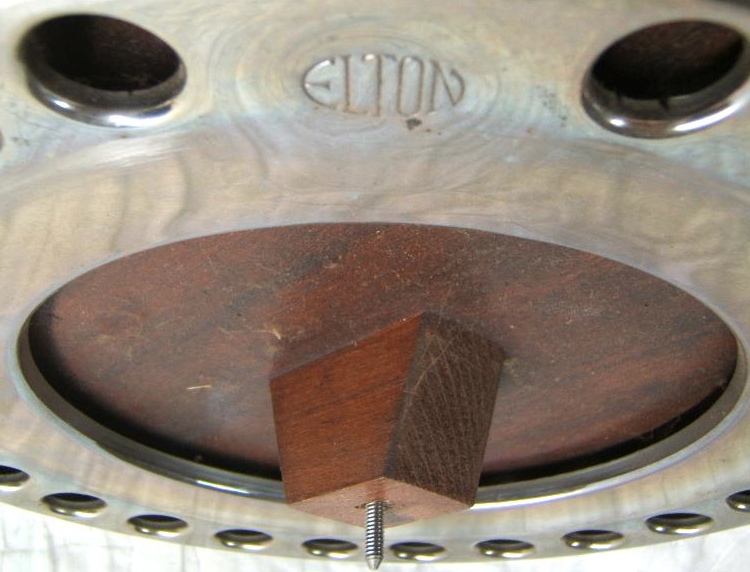
So - it has to be that resonator and that chrome flange with portholes that's special. And notice how the pot of the uke actually sits directly against the flange - that's not only unique among S-V ukes, but also very rare amongst all kinds of banjos.


You'll also notice from this shot how much larger this resonator is than on any other model of S-V banjo uke. It's a good three inches larger in diameter. Also - note that it was made with a purfling ring on the back and also in a three-piece style enclosing inlay as seen in the topmost of these two examples of the instrument.

Just recently, a Buster Brown (sans logo) came up on eBay that showed just how the resonator attaches - note the block that serves as the spacer.


Also note that the brand name 'Elton' is stamped into the flange in the place that would normally be placed under the heel. We've got to thank the seller for not attaching the resonator right to show us that detail.

Elton is the Chicago-based company that made capos for ukuleles, banjos and guitars in the twenties and thirties, but here, their logo on the flange seems to indicate that that Elton manufactured the flange for Stromberg-Voisinet.  


There's also a version of the flange made for the "Buster Brown" that has a raised 'grommet' around each resonator hole; whether that version was manufactured by Elton, I can't say yet.

We have a few more styles of S-V uke to cover here, but next time - onto something a little different. Until then - keep on strumming.

Sunday, March 4, 2012

John T: Banjo Ukulele Hero

I wanted to take a minute to note the passing of John Thompson - John T to his customers and friends - to stroke.
John was from the UK. Here he is on a trip to the New York Ukulele Festival; while here in NYC, he bought a vintage Gibson ukulele at Mandolin Brothers on Staaten Island.

There are not that many people who are truly schooled in banjo ukuleles, but John T was one of the most knowledgeable out there. More importantly, he shared his knowledge, freely and happily, with those of us who were trying to learn more or trying to figure out how to set up to produce a great sound or the right action.

John's son James broke the news to his friends and acquaintances on Ukulele Cosmos this week.

When I was researching Stromberg-Voisinet ukes some years ago, I found John playing his S-V-made Wizard uke on You Tube. He answered my request for info right away and gave more than I asked for. Everyone on the Cosmos tells a similar story.

John's Ukulele Shop has been a great resource for new players, and you can find it in my links section at the bottom of each page of this blog.

Those who were lucky enough to spend time with him talk about his generosity of time and spirit, but they also talk about how much fun he was to be around.

He was 52. Take a moment to lift a glass.

Sunday, February 12, 2012

Stromberg-Voisinet Tenor Banjos


There's something you notice in this ad from Stromberg-Voisinet - other than the fact that they were electrifying guitars and banjos (!) in 1929, and that's the fact that I've only ever seen these four types of instruments - guitars, parlor guitars/tenor guitars, tenor banjos and banjo ukuleles, but never seen an S-V wooden uke or mandolin. This, even though they started life as the Groeschel mandolin company at the turn of the 20th Century. If you're interested in how Henry Kuhrmeyer offered electric guitars and banjo ukes, read on at Vintage Guitar Magazine


This ad, which was originally sent to me by my friend Chris Jameson, prompted me to look for tenor banjos with the Stromberg earmarks and decorative features, including a three-lobed headstock, decorative pearloid, purfling, resonator decals, and a recessed resonator attachment, and they appear to be very common, and were likely a big seller for the company. Most interesting is that they're like big versions of the banjo ukes they produced.


For example, here's their tenor version of the "Rose". This brand, Howard, was sold by Wurlitzer, but clearly, Stromberg-Voisinet supplied the instruments for Howard; an example of a double-jobber.


Note the same russet-stained walnut, the rose decal, the same chrome recess that holds the attachment screw, and the five-piece neck, in common with the Rose banjo uke. The family lineage is pretty clear in these full-size tenors.


You'll also notice the floral/foliage designs on the metal ring around the pot and on the resonator and bezel ring look very much like the designs on the pot of the Stromberg-Voisinet Crocodile-skin ukuleles.


Also, notice that three-lobed headstock, which is a fairly consistent feature of S-V banjos.

You can also find, in the fretboard MOP marker, the S-V diamond logo.

When the company became Kay, they apparently continued to use the necks/headstocks,
hardware and
flanges that they had in stock, and then began to develop other headstocks and flanges, so you'll see these headlock and flange designs on Kay banjos from the 30s and even beyond. Here's a flange design common to both Kay and S-V productions.


Here's a Clarion - which uses the same lousy decal that we saw on the Clarion banjo uke - it's even affixed sloppily, just as we saw on the Clarion that Allen Harris had for sale some months back. Clearly, the folks at Clarion were more concerned with moving their instruments out the door quickly, but the name can't disguise the origin of the instrument: same headstock, same flange, same company.


These tuners, very simple and inexpensive looking, may have been fitted at Clarion's request. You'll notice that Grover geared tuners, including the excellent pancake tuners, are apparent on the other examples shown elsewhere in the entry.


Here's a version of the Rose decal again, and this Clarion almost looks like a cheaper version of the Rose made for Howard/Wurlitzer above - three-piece instead of five-piece neck - with a sunburst finish on the resonator.


Here are a few additional banjos, all show the trademark headstock and other S-V features.


Conqueror - not one I've seen before, but very nice inlay work on the headstock script.


As you'll see, its a tenor banjo version of the banjo uke Style 1 "Black Beauty". It even has the same kind of turned resonator.


Even though the pot on this banjo uke is chrome-clad, you'll see the Style 1 purfling still makes its way into the mix, but around the resonator outer edge.


Here's a Stromberg-Voisinet banjo sold under its own name - note the label from the inside of the pot, which offers instructions on how to use the S-V coordinator rod, which replaces the dowel seen on the other banjos in this entry. It's very similar to the coordinator rod patented by Gibson, as you can see in the second photo.


This one has an interesting resonator back decal.


Geared tuners, five-piece neck.


Below is a Stromberg-Voisinet with a Wilson Brothers decal in the resonator - just as we've seen before in this blog with the Wilson Brothers-labeled style one and style four ukes.


This banjo has the same resonator assembly and pot with chrome ring that we saw on the 7" Wizard banjo ukes.


Another unique resonator decal on this example.


Finally, I've thrown in some pictures of a Stromberg-Voisinet Key-Chord, a sort of push-button banjo from the 20's, built for the person who played guitar and didn't want to lean the fundamentals of tenor tuning. Oddly, it seems more difficult to get good at this instrument than it does to get good at a tenor, but hey, they must've sold quite a few of them to make them worth building. The mechanics of this instrument are interesting. I'd seen one deconstructed once...


Here's the panel of chord buttons. You depress the chord you want, and a template descends on the machinery of linkages, depressing the string and pressing it against the fretless fretboard. I've never played one, but there have been three on Ebay in the last two years, including one that never seems to move that's for sale right now. So you have a shot at it! :)


I realize there's nothing TRULY uke oriented here, but I couldn't resist showing the big brother of our little banjo ukes since the family resemblance is so strong - and the same situation of misidentification or no identification follows these particular S-V instruments as well.

OK - I realize this entry may feel a bit like your uncle's slides of his trip down Route 66, so next time - I'll be back on ukuleles and the blog will be a bit shorter. ;)

That's it for now. Until next time, keep on strumming'