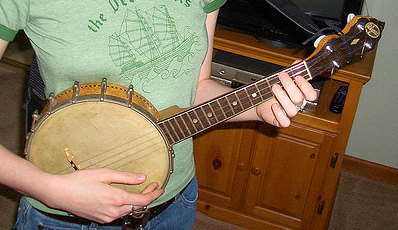
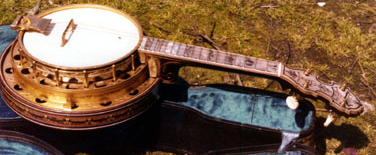
Notes on playing the banjo uke (and the regular ukulele), as well as some of my favorite songs and videos, but mostly, you'll find information here on my particular obsession - the many models of banjo ukulele offered by Stromberg-Voisinet in the 1920's to 1931.

Monday, January 22, 2018

What The Heck IS This?

Greetings, friends -

It's been a long while.  If you're still out there, here's a couple of bits of news...

The Buck and a Quarter Quartet is performing four shows in February in Manhattan and all over Brooklyn, including Pete's Candy Store, Red Room, SISTERS Bklyn and Jalopy Theatre and School of Music.  We'll have some great guests at these venues; to find out who (you'll know when we know), then just follow our schedule on our website or via Facebook, or sign up for our mailing list here if you'd like to get two emails a month from me.

It's kind of pointless to describe music, but we are often asked what kind of music we play. "What IS this exactly?" we're asked at nearly every show these days, mostly in a positive, curious way.

We haven't really got an answer, so I turn to you.  How would you describe this kind of music? What category is it in?  None of the answers we give - i.e. traditional jazz, hot jazz, vintage pop, etc. seem to satisfy our questioners.

Here are a few recent videos to get you thinking...

That's our friend, the amazing Kat Edmonson, singing "Deed I Do".

"When I Take My Sugar to Tea," one of our signature numbers.  I get to play uke on this one; I say "sorry" on this to the poor couples dancing off camera...

John Gill plays this lovely old chestnut..."Someday Sweetheart".

Our own bass player Brian Nalepka puts forward the idea that we're a skiffle band that plays tunes a skiffle band wouldn't normally play.  That seems logical, but I'm still interested in your take.  Please, let me know in the comment section.

Until my next post, keep on strummin'!

Sunday, February 28, 2016

I'm Going Back To My Dreams

In my last entry more than a year ago, I posted a video of an original Christmas tune I'd written the year before.  Seems like my output has slowed to an annual crawl, but in fact, I've never been busier, thanks to our band, the Buck and a Quarter Quartet.  Playing music of the 20s and 30s, we're now doing about four gigs a month, and since I'm playing clarinet, saxophone and tenor banjo, there hasn't been a lot of time for me to play ukulele, let alone post about it.


But, I have been writing over the last year and have about a dozen songs.  This is one of them, "I'm Going Back to My Dreams".  Writing it took me back to dealing with that sinking feeling dealt by a less than true (now ex-) girlfriend and the curious elation you get (at least I did) when trying to keep your spirits up by retreating into fantasy.

https://soundcloud.com/jnobianchi/im-going-back-to-my-dreams


I also did a short video of the chorus, no verse - as I wasn't yet happy with the verse at the moment I recorded this.  With two teenage daughters and a dog living in my two-bedroom apartment, my videos always get recorded wherever I can find a quite spot.  It isn't always a great looking spot, though!


Just so you know, I recorded the SoundCloud file not on a uke, but instead, playing a 1928 Gibson TG-0 tenor guitar.  Tenor guitars were the music industry's answer to the question, "what should tenor banjoists play during the ballads that were becoming increasingly popular by the late 20's?"


The Gibson looks a lot like a big uke. When I play this little guitar at gigs, I occasionally get asked if its a bass ukulele.  In the You Tube video, I'm playing Prince Wong's Martin style 2 standard uke.

Any road, I hope that you enjoy this song, and I'll record a few more of the originals I'm finishing up soon.  Until then, keep on...

Wednesday, January 7, 2015

Happy New Year - The Holiday Creep

Happy New Year to those still following this infrequently posted blog. I hope that you had as good a holiday as I had!

I hate to recycle old material, but in keeping with the burgeoning green economy, I'm re-doing last year's Christmas song. I don't think I did such a hot job on the recording you might have seen on the blog from last year, so here's a newer, pared-down version of a tune I wrote called "The Holiday Creep".


Based on the kind reaction from several friends whose opinion I trust, I may post more of the many songs I've written, but haven't had the stomach to share with you before this.  Thanks friends and you know who you are...  :)

News to report: my band, the Buck and a Quarter Quartet, starts 2 residencies this month,

The first at Freddy's Bar on 5th Ave and 18th Street in Brooklyn's South Park Slope area, where we play the second Friday of every month at 8-9 p.m.  The second residency is at one of my favorite places to eat and drink, Jimmy's, which is at 43 East 7th Street, and we play there the last Thursday of every month, 9-12 p.m. We'll be joined there by special guests from the traditional jazz community.

Now, you might say, "Hey, John, that's not a quartet."  To that, I would reply, "Yeah. So?"

Keep on strumming and Happy New Year!


Saturday, August 16, 2014

"Why" Jelly Roll Morton


Not a lot to say about this number, learned from listening to Leon Redbone and Stovepipe Daddy.  Try finding the music for this one, I dares ya.

It's a tune I'm told is from 1938, though it feels like Jelly Roll Morton might have written it earlier, but not published it before then.  Jelly Roll always used to make statements like "I invented jazz" and even though you have to figure a large ego was at work, when you take everything he wrote and recorded into account, he may actually be judged as correct.

"Why?" is played in C, on Prince Wong's Martin Style 2 from the early 20's.  By the way, the uke was stained dark by Prince Wong or someone on his behalf, in case you're wondering why it is nearly black.

Enjoy, if possible.

Monday, February 10, 2014

"That's Why They Call Me Shine"

Written in 1910, lyrics by Cecil Mack and Lew Brown and music by Ford Dabney, "That's Why They Call Me Shine" became a jazz standard. Nowadays, it gets played a lot more than it gets sung.


The reason is pretty simple: it's hard to sing the lyrics. They are seemingly rooted in the 'coon song' tradition, and are full of the kind of references you associate with blackface performance, but it's actually not that simple a tune.

For 1910, "Shine's" theme was a surprising one for popular music - it wasn't minstrelsy so much as a commentary on it, and it may or may not have been inspired by an incident in the NY City race riot of 1900.

I haven't done the verse here, only the refrain, but I have the lyrics to both below from the original sheet music:

Verse:
When I was born they christened me plain Samuel Johnson Brown
But I hadn't grown so very big, 'fore some folks in this town
Had changed it 'round to "Sambo"; I was "Rastus" to a few
Then "Chocolate Drop" was added by some others that I knew
And then to cap the climax, I was strolling down the line
When someone shouted, "Fellas, hey! Come on and pipe the shine!"
But I don't care a bit. Here's how I figure it:

Refrain:
Well, just because my hair is curly
And just because my teeth are pearly
Just because I always wear a smile
Likes to dress up in the latest style
Just because I'm glad I'm livin'
Take troubles smilin', never whine
Just because my color's shady,
Slightly different, maybe
That's why they call me shine.

The first time I heard the verse was back in 1980 or so when I bought Ry Cooder's excellent album "Jazz", which really is an amazing record.

I love Remco Houtman Jensen's (Ukulelezaza's) take on this tune, and my approach is fully inspired by his fantastic version, here heard in a medley with "Five-Foot-Two".

Both ukuleles are Ludwig Wendell Halls from the late 20's, a great instrument. Mine has been made even easier to play by the great repair work of Mamie Minch, who runs Brooklyn Lutherie with Chloe Swantner. I recommend their shop highly for all your fretted instrument or violin repairs!

Tuesday, December 24, 2013

Merry Christmas - The Holiday Creep

Happy holidays to you, if you're checking this before or during the big Christmas day-off. If you're like me, and God help you if you are, you celebrate a combination of Christmas, Hanukkah, Yule and Saturnalia, with heavy emphasis on the last one (ie. drinking, feasting, gift giving, the tree - all Saturnalia contributions, by the way), but instead of a slave, we traditionally sacrifice a couple of lasagnas.

Speaking of tradition, I was immensely happy to have been included in Meg Reichardt and Kurt Hoffman's tradition. Meg and Kurt are the nucleus of Les Chauds Lapins, the truly wonderful banjo-uke focused sting quintet that plays the pop and jazz of of 1920s-1940's France. Every year, they host a holiday recording party in which Meg records an entire album of original holiday songs composed especially for that year's get together. Just take a look at who's on the album and you'll see I'm playing above my weight.


I had a great time and was truly honored to have been invited to join in on several songs, in addition to playing my own tune, "The Holiday Creep".


Have a happy holiday, whichever one you celebrate, and do remember what they're really all about: hanging out with people you love, and eating and drinking just a little too much.

~ John

Tuesday, December 17, 2013

The Joy of Plastic

Wow. Wait a minute! Is that...? Yes, it really is!

A Flamingo!

OK, perhaps I wouldn't be as excited about this little plastic Flamingo ukulele if it weren't for the fact that Ms. Page is holding it en déshabillé, but there are plenty of people out there right now, after seeing this, who are excited by...plastic ukuleles, God help them.

This particular instrument is a molded styrene-plastic concoction, and these and millions like them were inspired by or built by guitar designer and maker Mario Maccaferri. They were produced in the fifties, and surprisingly, they aren't junk - not by a longshot. I've got many friends who collect plastics, play them and will go to lengths to keep them playable (plastic has a tendency to degrade over time, and the top is sometimes in need of shoring up after decades of being under tension from the strings). They aren't rare, and there are many kinds, but the best are those built by Maccaferri: the Islander and the TV Pal. They're real instruments, fun to play, and certainly unique in sound.

For years, I'd been told that the other popular plastic uke of the 50's, the Mastro TV Pal, was the main competitor to Maccaferri's Islander range. Nope. They are both Maccaferris, as evidenced by the identical bridge and saddle construction, headstock, neck, fretboard and just about everything else about them. Turns out that Mastro is the name of the company that did the injection molding of the Maccaferri TV Pal instrument (a company in which Maccaferri had a controlling interest). Earlier models don't say Mastro on them, but they were also molded by Mastro.
Whether they said Mastro on them or not, Maccaferri still got the lion's share of the between $2.70 and, later, $5.95 that they cost the American suburbanite. A pretty good value, regardless of the material of construction. Here's me playing a TV Pal at Rivington Guitars last year. It sounds...well, pretty good, even if I don't!


And it turns out that the name 'TV Pal' is a tribute to Mr. Maccaferri's TV pal - the fellow who endorsed his instruments on his coast-to-coast broadcast in the early 50's - Arthur Godfrey. Most of you will know that Godfrey was the popularizer of the baritone uke, a new instrument at that time. He also played tenor banjo in Chicago tuning, and rumor has it, he wasn't a very nice man. My grandmother - not very nice herself - loved him, for what that's worth.


Here's another uke Godfrey endorsed - The Flamingo, though slightly different from Betty's above. This one is fitted with a Maccaferri device - with Godfrey's name right on it - the patented 'uke player,' which allows you to play six chords with just the press of a button. Like the Maccaferri, the Flamingo was manufactured in durable 'Styron.' The Flamingo was the chief competitor to Maccaferri's plastics. I've never played one, so can't vouch for its qualities.

Apparently, sopranos aren't the only ukes that Macaferri made. Here's my friend Chris Tarman, who is a great player and has some amazing ukuleles, with an excellent view of his ultra-rare Macaferri Islander baritone ukulele. Note the amazingly helpful cut out that allows the player to fret the uke right up to the sound hole! Macaferri also offered a TV Pal baritone uke, in addition to the soprano.


So, it turns out that while the prop person over at Irving Klaw's photographic establishment on West 14th probably just went out and got the cheapest ukulele they could find for Betty, they picked one of a type that has become oddly collectible, very playable and certainly the object of much affection.

Still, as nice as it is, I find it very easy to look past the neat little plastic ukulele in these photos. I wonder why?

Hmmmm... I'll think about that one upon closer study...

Saturday, December 7, 2013

Waiting at the End of the Road

If you know Patsy Monteleone, you already know how great a player and singer he is.  If you don't, you're in for a treat.


Patsy recorded this as a tribute to Brian Newman, a friend of ours from the Ukulele Cosmos, who passed away earlier this year and whose birthday would have been today.


Thursday, December 5, 2013

"Golden Gate" Gibson UB-5 Banjo Ukulele


Since last month, I've been playing a good deal, first Ben Mealer's and my little trio, "The Three-Quarter Quartet", both at Sonic Uke's Halloween Ukulele Cabaret and then at the Jalopy Theater, and with "Amity Rose & the Dead Cowboys" at Joe Silver and Suzy Savoy's "Ukulele Rumble" and again this Saturday, 10 PM at the Vagabond Cafe on Cornelia Street in NYC.  And, next Friday, again with the 3/4 Quartet at the Holiday Ukulele Cabaret at Jimmy's No. 43, 7pm on East 7th Street, with more holiday stuff coming up.


I haven't done a lot of videos lately, but here's one from just a couple of days ago - A 1928 number that was a hit for Al Jolson, written by him, Billy Rose, Dave Dreyer and Joseph Meyer.   A fun number to sing and play, and - as I just got my Gibson UB-5 back from being repaired at TR Crandall Guitars - I though this would be a good opportunity to hear this instrument.

Here are a few photos of what was the top-of-the line of Gibson's banjo ukulele range of instruments.  This 1926 UB-5 is my favorite uke for a couple of reasons.


In terms of sound, its not like the Abbott and Ludwig banjo ukes, which are more lightly built and which have a flange and pot that are integrated and made of cast alloy.  The Gibson is heavier, and the pot is a laminated ring, very much the same as the pot on the basic UB-2/UB-3 ukuleles.  Coupled with a metal - I think brass - flange and a full walnut resonator, the Gibson UB-4/UB-5 and UB2 Deluxe/UB-3 Deluxe are HEAVY.  However, with that brass tone-ring, the sound of the UB-4/UB-5 is anything but heavy.   If anything, its mellower than other Gibsons, and reminiscent in tone (and very similar in hardware) to their Mastertone line of banjos.

Anyway, I'm no Gibson scholar, but I can tell you that despite the weight, this is the best playing instrument I have and certainly the best uke I've played.


I'm the second owner of this particular uke, and at some point in the 40's, the uke met with an accident and lost a section of the resonator rim on the player side.   you can't really see the rim in this picture (you can see it better in the above shot), but the crack, which I just had glued closed, doesn't effect the sound at all.


In addition, over the years, the gold plate has worn away in places leaving the flange green in places and worn and grainy all over.  Either you hate this and have to have it re-plated, or you look upon this as original condition and would never touch it.  Me, I fall into a third camp: is it rusting and does it need repair?  If - as in this case the answer is, so far, "no," then I don't touch it.


Gibson really pulled out the stops on the UB-4 and UB-5's decoration, but it's always tasteful.  The UB-4 is identical except that it's overall nickel-plated, not gold.


On the UB-5, even the barrel tuners that Gibson seemed to use on everything are gold-plated.   So are the Presto tailpiece and the little screws that hold the resonator firmly in place.


Though the finish is gone in several places on the resonator back, I like the worn, non-flashy look of this UB-5.

You can see the fellow who originally owned it played the heck out of it and never left it sitting in it's case, which you have to like in an instrument that has retained its characteristic sound.

Played and cared for to a degree, but not babied.

See you next time...


Thursday, October 31, 2013

Stromberg-Voisinet Aero Uke and Rose Banjo Uke, and Harmony Roy Smeck Vita-Uke


It's my birthday Monday. 50; one of the big birthdays, the kind you get a good present for instead of socks and a book. My family gave me a 1924 Gibson L-Junior guitar. A great gift, but to make room for it, I'm going to have to sell a couple of ukuleles. I just sold this extraordinarily nice Harmony Roy Smeck "Vita-Uke".


The uke had one minor problem - a dent in the back - plus a replacement bridge, but the tone was excellent and it reminded me of a Martin uke.


From the triple black, white and tortoiseshell top binding to the trained-sealion soundholes, Harmony really did a wonderful job back in the 20s and 30s.


The other uke I'm selling to make room for the guitar is a Stromberg-Voisinet Rose. I've never posted pictures of it here, but I've taken a few so that you can see the top of the line S-V ukulele before it sells on eBay.


Note the pearloid (or mother-of-toilet-seat) facing on the headstock and fretboard, which contrasts interestingly with the mother-of-pearl position markers, making them look silver in comparison to the milky color of the fretboard.

Also note the rose decal and other typical Stromberg-Voisinet design features, including the purfling on the pot and the five-piece neck and the three-pointed, scrolled headstock always found on S-V ukuleles.

That headstock comes into play in identifying the next uke...

Finally, here is one I never owned, but it bears mentioning that it is an AMAZING design and this is in fact a Stromberg-Voisinet ukulele.


The "Aero-uke" as its known is constantly mis-identified as a Harmony product.


If you follow this blog at all and have seen the dozens of examples of S-V ukes with this exact headstock and neck, then you recognize the instrument's origins and know that this is a Stromberg-Voisinet product.


Of course, that said, you've never seen any other ukulele like this one, and those "jet-engine" soundholes sure are unique.


Of course, this is the only S-V instrument I can think of that actually has a rudder attached to the headstock!


Several of you have pointed the "family resemblance" of the Aero-uke to me over the last few months, and I'm glad to be able to put this one in the right family.
Here's a shot from of the carved tailpiece and, well, propeller, I guess!


And - after I wrote this draft, look what I found online. Proof positive that this is a Stromberg Voisinet. Thanks to folks who saved these old ads!


Anyway, that's all for now. Happy Halloween!

Monday, October 21, 2013

"So Long Oolong How Long You Gonna Be Gone?"

Bert Kalmar and Harry Ruby wrote dozens of satirical or downright silly songs during the golden era of Tin-Pan Alley's heyday.  I do several of their tunes, including "Father's Day" a song they wrote for Groucho Marx (they wrote several for him, including "Lydia the Tattooed Lady") and "The Sheik of Avenue B", a parody of "The Sheik of Araby" that they wrote for Fanny Brice.

This tune is clearly a mild parody of Madame Butterfly, but it's a thin little piece of fluff that doesn't need to be analyzed, just played.


A quick thought on the subject and it's treatment, though.  It has a mildly racist approach, but that's typical of what was a far more unapologetically racist time, the 1920's.  And when you come down to it, this tune isn't even remotely malicious, so I wanted to do it.  However, I don't know that I'd feel comfortable playing "Ma is Playing Mah-Jong".

Monday, October 14, 2013

Your First Ukulele

If you play ukulele (and I'm assuming if you're reading this, you do), you had a first instrument. Maybe it was a good ukulele, more likely it wasn't. Perhaps you sold it off, or maybe you still enjoy playing it.

Here's the latest installment of our round-robin blog project; this time, we're focused on our first ukuleles, what kind they were, and what we've learned and how we might approach the uke differently since we first started playing.

And while we're on the subject, here's a photo of what my first ukulele looked like, a K. Yasuma ukulele from Japan. It was a great sounding instrument, and I've read in a few places that Yasuma was sued by Martin for copying their designs and brand pretty much exactly. I don't know if this is true or not, but I'd also read that Yasuma lost the suit and was ordered to stop making and selling these instruments (guitars and tiples as well as ukes), and that many of the instruments were destroyed. Either way, you can't find Yasumas nowadays, which is too bad. It was a great ukulele~!

Saturday, July 6, 2013

Four Uke Bloggers on Creating Original Arrangements

For this entry, four ukulele bloggers are contributing original arrangements for you to try. For this installment of our "carnival blogging", I asked four of my fellow bloggers to take a melody they knew and build their own chords to create an original arrangement, supplying us with a video and a lyric and chord sheet. I think the result is really instructive and I hope that you enjoy it!

--------

First up, me. I chose a tune that Bing Crosby recorded in 1932 called "I'll Follow You".

Bing Crosby

I started by figuring out the melody, then adding very basic chords. Once I got those first two steps down, I decided to add some interest to the arrangement by combining melody and chords in an introduction, adding turnarounds between verse and refrain and also between phrases, and creating "walking" patterns (where we change chords by literally descending one note in each chord by a half-step).

Here's the resulting video and here's the chord sheet if you want to play the tune and work up your own variations:

I'LL FOLLOW YOU
Fred E Ahlert (m) Roy Turk (l) 1931

(F) Life was as (Bbm) sad as could (F) be, dear,
(Dm) Till you came (Am) into my (Dm) heart.
(Edim7) Life now is (A7) heaven to (Dm) me, dear,
(Gm) No-(Gm[Maj7])-thing can (Gm7) keep (Bbm) us a-(C7)-part, (C+) so;

(F) Anywhere on earth you may (C#7) go,
(Dm6) (G7) I'll (Gm7) follow (C7) you.
(F) Through the rain or over the (C#7) snow,
(Dm6) (G7) I'll (Gm7) follow (C7) you.
(Gm) No sea could be too (Bbm) wide,
(F) I'd cross the great (C#7) di-(D7)-vide
(G7) Just to be at your side,
My (Gm7) dar-(C7)-ling.(G7) (C7)

(F) Distance cannot keep us a-(C#7)-part,
(Dm6) (G7) I'll (Gm7) follow (C7) you.
(F) Sheltered by the love in my (C#7) heart,
I'll (D7) see it through.
(Gm) Wherever you may (Bbm) be,
(F) You can depend (C#7) on (D7) me,
(Gm) Un-(Gm[Maj7])-til e-(Gm7)-tern-(Bbm)-i-(C7)-ty
I'll follow (F) you. (Bbm) (F)


Miles Ramsay of UKEonomics.com has contributed his arrangement and video of Randy Newman's "You've Got a Friend in Me":


Buzz and Woody

Here's the link to my video...

...and here's the chords.

(C) You've got a (G+5) friend in me (C) (C7)
(F) You've got a (Cdim) friend in me (C) (C7)
(F) When the (C) road looks (E7) rough a (Am) head
And you're (F) miles and (C) miles from your (E7) nice warm (Am) bed
(F) Just rem (C) ember what your (E7) ole pal (Am) said
Boy, (D7) you've got a (G7) friend in (C) me

(C) You've got a (G+5) friend in me (C) (C7)
(F) You've got a (Cdim) friend in me (C) (C7)
(F) You've got (C) troubles. (E7) I've got 'em (Am) too
(F) There isn't (C) anything I (E7) wouldn't (Am) do for you
(F) We stick to (C) gether, we can (E7) see it (Am) through
Cause (D7) you've got a (G7) friend in (C) me (C7)

(F) Some other folks might be a (B7) little smarter than I am
(C) Bigger and (G+5) stronger (C) too (C7)
(B7) But none of them will (A9) ever (Fdim) love you the (Em) way I (A7) do
It's (D7) me and (G7) you, boy
(C) And as the (G+5) years go by (C) (C7)
Our (F) friendship will (Cdim) never die (C) (C7)
(F) You're gonna (Cdim) see it's our (C) des (E7) tin (A7) y
(D7) You've got a (G7) friend in me (C) (A7)


And here's "Maybe" by Thom Pace, arranged and performed by FriendlyFred of uke4u.com


Dan Haggerty and Ben

Remember Ben the Bear?

Yes, that was the TV-series “The Life And Times Of Grizzly Adams“. Here's my instrumental rendition of the theme song by Thom Pace.


Download lyrics and chords here.

It sounds better with low 4th than reentrant tuning.

I played it in dropped D tuning ( D G B D' ).
Just tune the first string of your baritone ukulele 2 tones down.
You find the chords for the song in this tuning here.

Cheers FriendlyFred (uke4u.com)


And here's Daniel Hulbert's take and arrangement of "Spangle".

This song was written by The Wedding Present for the album "Watusi" (1994). I first heard this song from a cover on the album "Singles" (2000) by Jimmy Eat World.

Watch on YouTube or via this link

Chords Used

B♭ Gm B♭sus4 F Fadd9 Gsus2
3 3 3 2 0 0
2 2 3 0 0 2
1 3 1 1 1 3
1 1 1 0 0 0

Intro/Chorus
B♭ --> Gm B♭ --> Gm (Use little finger to hammer-on the 3rd fret of the "E" string on the B♭ to Gm transition)

B♭ B♭sus4 B♭ (Use little finger to do three pull-offs on the "C" string on the B♭sus4 to B♭ transition)

Verse
B♭ F Fadd9 B♭
B♭ F Fadd9 B♭
B♭ F Gsus2 B♭
B♭ F Gsus2 B♭

Ending
B♭ Gm B♭

Daniel Hulbert - circuitsandstrings.wordpress.com

That's it for this installment. Please follow Miles, Thom and Daniel - and our fifth partner, Ryan ukulele play.com, who wasn't able to join in this time.

Until next time, keep on strummin'.

John

Saturday, February 16, 2013

What Is This Uke?

In December, I bid on a small banjo ukulele on eBay with a resonator back and perloid lamination on the fretboard and headstock. No vellum, bridge or strings, and - alas - no name.


So, what IS this ukulele? Well, there are a couple of clues. First, there's that headstock...

Dallas & Sons?

I think it DOES look like John E. Dallas & Sons. There's really no other company headstock that looks exactly like this. The most similar - Gibson - is not proportioned quite like this. And yet, nothing else on this ukulele looks like a Dallas...


...for example, there's the pot and resonator, which are both encircled in purfling. IT looks like an American-made ukulele.


And then there's the resonator, which is attached in a manner that's typical of several American brands, most notably Slingerland, Lyon & Healy, and J.R. Stewart. But, this instrument really doesn't look like any of those, and as you can see here, it doesn't look like a Stromberg-Voisinet, which typically uses a chromed recessed cup for the attachment screw.


Then again, the purfling, the screw attachment, the pearloid laminate and even the painted faux ebony binding look a lot like what Stromberg Voisinet became in 1931 - Kay. You may remember that Kay used identical binding on their early banjos and we saw an identical resonator attachment screw on the back of a Kay- or Stromberg-Voisinet-built Wizard in an entry I posted more than a year ago on Wizard Ukuleles.


Then, there's this: to keep up with customer demand, John E. Dallas & Sons imported more than 3,000 Kay-built instruments in 1930s; most of those instruments were guitars, but other instruments were included in the shipment, though they're not named in the source material I've found.

And, this passage comes from the Jedson Guitar website

"Dallas imported musical instruments from Germany, Italy, Czechoslovakia, and the USA (including Kay, Harmony, and Vega.) The Radiotone branded guitars appear to have been made in Czechoslovakia, although at least one model branded Radiotone was made by Kay in the USA..."

In recent years, we've seen Slingerland-built instruments coming up for sale on eBay with with UK seller's marks on them. Perhaps - and it's just a theory as I've never seen more than one of this particular ukulele - perhaps Kay built instruments to meet Dallas's specifications, which included recreating the Dallas headstock to keep some brand integrity?


This is just a guess as to who made and sold this particular ukulele, and it seems to match the facts, but only just. You might have noticed that the resonator is split and it turned out that the resonator back came off in shipping, and the neck turned out to be completely warped and unplayable. And so, back to the seller it went, sadly.

If anyone reading this has more definite information, or a plausible explanation as to who built this ukulele, please let us know. Until then, keep on strummin'.


5-17-13: An UPDATE!

Well - happy to say I think the mystery is solved.

I always assumed that the above ukulele was intact. It isn't.

I've found a photo of the same uke, but this one has the flange that was missing from the above example.


And that flange tells us this was a Harmony. And that makes sense, as we know that Harmony was one of a handful of firms that supplied Dallas with instruments.

So, I'm glad to be wrong, and also, I'm *very* glad that I sent back the uke to the seller.

OK, next up a post on a Stromberg Voisinet rarity and some sheet music and other cool stuff to follow that.

See you later!


Monday, December 17, 2012

William Lange & Co., Part II


Just getting ready for two holiday performances this week; tonight (Monday) I'm playing uke and singing with Margaret Gianquinto for her "Old Fashioned Christmas" evening at ZirZamin, and on Friday, I'm playing with Patsy Monteleone at the Ukulele Cabaret at Jimmy's 43. There are a lot of Christmas tunes involved... as 'tis the season.


So, as much for me as anyone else, I need to cleanse my palate and talk about something that isn't Christmas related for a few minutes. Warning - this post is 'geekier' than normal...

Back in September, I wrote about the different lines offered by the New York City-based William Lange and Co.; Lange, Lange Solo, Banner Blue, White Swan, and Langstile. All of these lines, with the possible exception of the White Swan (which seems to have been limited to one or two models), seems to be complete lines of ukes, with modest flush-backed resonator models, open resonator and flanged resonator models topping the ranges.


But, Lange also made instruments for other manufacturers, notably Bruno NY and Vernon for Bruno, Henry Stadlmair's Avalon, Montgomery-Ward's Concertone, Wizard, Sears's Supertone, Blue Boy, El Beco, Tourraine, and others. Looking at a few, you'll see some definite Lange signature marks.


Avalon - Henry Stadlmair & Co. at 117-117 East 23rd Street was founded as an importer of foreign-made instruments and a retailer of domestic-made instruments. They specialized in guitars, Weissenborn Hawaiian guitars and other stringed instruments, and eventually, when the uke craze hit, they started selling ukes and banjo ukuleles under the name "Avalon" - one of which is at the top of this entry.


Some of these were made by Slingerland and perhaps others, but the vast majority of those you'll see with this imprint are Lange-made instruments.


Basic, open-backed models, they do appear in some nice finishes for an inexpensive instrument, with green and aquamarine two-tone finishes often appearing, besides the more common blond and black. They follow a very basic Lange design seen used by other retailers and brands.

P'MICO - the "Progressive Musical Instrument Company of NY" P'MICO didn't make their own instruments. Lange made this one for the company, which was their May Singhi Breen signature model. Note it's nearly identical to the Avalon above and the Bruno below; the difference is that it has a closed back with grommeted "Portholes" on the sides of the pot...


Bruno NY - Bruno, based at 351 4th Avenue in New York City, probably never made any banjo ukuleles; every time I've seen one with the Bruno stamp on it, it's clearly one that's been made by another manufacturer. Their Maxitone line are fun to play, and with their metal pots, they're pretty punchy.


Many of these seem to have been made by Chicago-based Richter and Co., though its possible that some which show headstock and pot variations come from other manufacturers. However, these photos of "Vernon", "Bruno", "Avalon" and "P'mico" headstocks side by side show the clear lineage of these brands as Lange-made.


Also, note the identical neck and pot construction between the models, very similar to other ukes Lange built for other manufacturers, as you can see in the Avalons and Brunos above. You'll also notice that all of the ukes on this page, from Avalon above to Wizard below all have identical hardware in the pot, as well as shoes and hooks. All have 16 tension hooks.


Vernon - a line offered by Bruno NY, the Vernon is a virtually identical instrument to the Bruno, but it's more of a budget model, with no inlays and the nameplate actually tacked onto the headstock.


Wizard - Some bloggers and collectors believe this is a Lange-made design. There are a good number of these out there. While I'm not 100% sure these photos actually show a Lange-made instrument, I believe they do.


There's good reason to to think that it is a Lange. The Wizard model depicted above has no sound holes and an open back. But, the model in the multiple photo clearly has soundholes and it resembles the design of the P'mico above with side grommeted soundholes and a closed back. While the headstock isn't seen on other Langes the way the Avalon/Bruno NY headstock is, my vote is still for these being Langes. The only fly in the ointment is the slotted diamond frequently seen on Stromberg-Voisinet headstocks, but then again, you also see that diamond in the more ornate Lange-made fretboards, so it doesn't bother me that much. I agree that these ukes are Langes.

And here's a uke that Simon Worthy put forward in our last entry, identified by the eBay seller as a Lange..


I didn't believe this was a Lange, with that slotted bezel ring and odd headstock. Were there designs put forward by Lange that have no relation to any other models or lines of Lange-made ukuleles?

Also - the resonator being attached by a button in the center back just doesn't seem to match what we see on every other Lange. The fretboard looks a bit like a White Swan's, but I felt pretty good that this wasn't a Lange.


Then Simon showed me this one. ID'd by the website as a Lange, I felt was VERY unlike any Lange I'd seen. Look at all that Pearloid and the shape of the resonator.


Odd. But it is similar in the bezel ring to the one above, as you can see clearly here...


And then, there is the clincher - the name "Lange" inlaid in the headstock - crudely, but distinctly. But what's with THIS headstock. Different from the one above and all others...


The whole thing was a puzzle and Simon and I have been going back and forth on this. Until now, I've remained unconvinced that this ukulele is a Lange. And then I found this one yesterday...

This uke has the same strange, externally slotted bezel ring, which I'd never seen before, but which is present on both of the above examples. Also, the headstock is more like that we've seen on other Langes, but still not a standard Lange form.

But, this last uke - with a very similar slotted bezel ring and pot, seems to lend weight to the idea that Lange made some very different, one-off or limited run instruments.

The inlaid Wm. Lange in the headstock certainly seems to lay this one to rest.


And finally, a few more Lange-made ukes:


Blue Boy - Actually not an instrument manufactured on contract, but made by Lange as a Paramount sub-brand. Blue Boys have some variation in models, and can be resonator backed or open-backed, as in these photos.


The uke in this YouTube video is missing its resonator, but you can see the attachment points.


Here's an Orpheum deluxe model...


And here's three shots of a "Super Paramount"...An AMAZING presentation model, which you can see on the headstock was a gift to the "King of Jazz" Paul Whiteman. That's his logo on the headstock; he was one of the few bandleaders to have a logo those days... And what do we find on the bezel - the clincher - the externally slotted bezel ring seen in the above one-off Lange models. OK, I'm happy to admit being wrong when the weight of evidence is so overwhelming. :)


In conclusion: Langes are mostly readily identifiable, fitting into several standard headstock shapes and pot designs, until they don't. The Orpheums, Paramounts, and the occasional odd Langes display an amazing variety and artistic flair, all with a high-level of craftsmanship. If you can find one in good condition - which isn't so often, sadly as they mostly offered low-to-mid-range, reasonably priced instruments, you may want to grab it. If you find one of their higher end ukes and you can afford what the seller is asking, pounce.

I want to thank both the Banjo Ukulele Haven and the comprehensive German site Banjoworld for many of the photos I used in this post. They are great sites that provide a wealth of information and you should go visit them.

That's all for now. If you got this far, you deserve a holiday gift. As I find additional examples of Lange-made ukes, I'll post them.


Until then, keep on strummin'...